
Category Archives: Artwork About Child
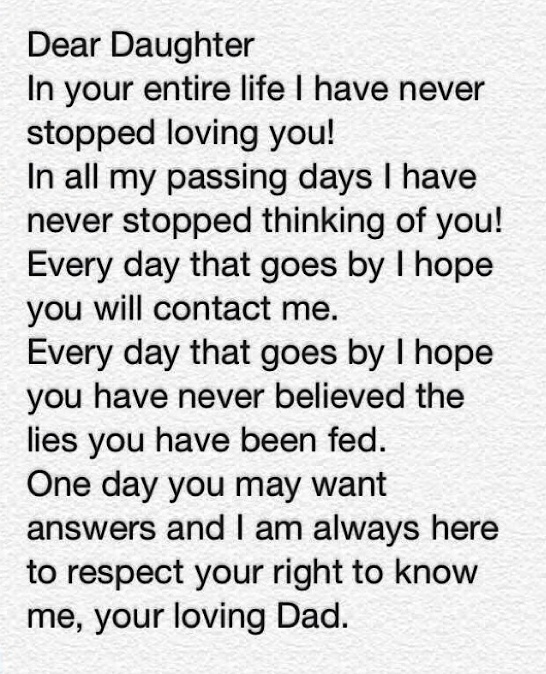
Mother “kept the hate alive all of these years”
Adult child of alienation discovers the concept of PAS due to experiences in a current marriage and is able to identify ‘what really happened’ after her parent’s divorce.
Story is published as shared by an adult child of Parental Alienation Syndrome.
“We are getting a divorce” I remember my mother saying. It was in 1981 so I don’t remember too much. What I do remember is a lot of conflict, mom crying and we all of course felt sorry for her. After the divorce, I remember a few times we went to see our dad. He told us that the white stuff in the orange peel was good for us. We went home and it became “Bob” (his title of Dad/Father was removed) feeds you orange peels instead of how he was teaching us about health. We basically made fun of everything and it made the visits with “Bob” feel like a joke. There was talk about child support and my teen brother stood up for my mom and punched our dad in the face. That was when the visits stopped I think.
I would write hate letters to “Bob”. Hateful cussing letters of what a terrible person he was for leaving us. My mother would tell me how good they were. There was no counseling for any of us. I moved out and I remember having an eating disorder. Looking back, I am sure it was due to lack of control over my feelings. I grew to know that “Bob was the enemy”, we just don’t like him. There was nobody there to insist that we have a relationship with our dad. There was nobody reminding us of anything good about our father. Only negative opinions about him, from our mother. Anytime I would say anything about him, it was laughed at. I had to watch what I said. I went from growing up with a quiet, peaceful dad that I loved, to learning to hate him. But there was part of me that kept wanting my dad. We were told that he abandoned us, that he didn’t love us.
I had many problems in my 20s. I had the most trouble with relationships. I couldn’t seem to make any work. I would cry so often but I didn’t really know why. Something was wrong but I didn’t know what. I went to group therapy and private but nothing seemed to help my heart. I think I was crying because relationships wouldn’t work, but now I look back and I think relationships wouldn’t work because I had a broken heart over the loss of my dad and I wanted a man to fix my heart.
After I married, we had two children. I took them to meet their grandfather and I tried to keep it a secret from my mother. It slipped from my daughter and my mother was mad. She gave me the silent treatment for taking our children to see their grandfather!! I didn’t really understand it at the time. I just went along with it.
The man I married had 4 children. They began to dislike us. We put a swimming pool in, got a trampoline and a new bike for the son and they had to go by their mothers rules at our house for those things. They weren’t even allowed on the trampoline. It was frustrating as I loved those kids. Slowly, things got more difficult. The kids would be cold when we picked them up. It would take a while to warm up to us. Their mother would call in the middle of our visits with them and she would come get them and we would be left wondering why they left. Things got so difficult and they were so disrespectful that we had them go back to their mothers. It was crazy. My husband and I are pretty peaceful likeable people and these kids were hating us. They ended up moving a half hour away and our phone was blocked. We didn’t know what to do. The mother wouldn’t let us go to counseling with them so we saw a dead end.
I began to research parental alienation as a friend mentioned it to me. I saw so many similarities to it and believed that this is what was happening. I read DIVORCE POISON. It was then that the light bulb lit brightly. That was it! As time went on I put more and more pieces together and was convinced that it was pa that had separated us from my husbands kids.
It was a birthday party for my mother and I heard her say how much she loved us and “its too bad the other parent doesn’t feel the same”. I think that was the moment I realized that our mother has been keeping the hate alive all of these years. Later, knowing Jesus is with me always, and having the love and support of my husband, I confronted her in email. I was too afraid to talk to her in person. I asked her if she really thought that our dad didn’t love us. No answer. I asked her not to say anything to us about our father unless it was a benefit to us. She rarely talks to me anymore. The threat she always hung over me of ignoring me came true. She pretty much ignores me these days. My own mother. I learned that she hates our father more than she loves us. Thankfully, I have learned that her childhood affects who she is and she never healed from having an alcoholic father. So I think I am ok not talking to her. Who wants to have someone in their life that really doesn’t care about them? She only wants me in her life if I hate my dad with her. No thanks. I have broken out of that hate jail and reunited with my Dad. I no longer refer to him by his first name. He is my Dad! Nobody will ever tell me who I can or cannot love again!
Thank you for sharing the sad situations and the heart warming story about reuniting with your dad.
Permission to use granted: 1/25/2015
Experience: I was a child affected by PAS
This story is disheartening! The sad part is that this is the unfortunate reality for some children.
Story is published as seen on Parental Alienation Awareness Organization (PAAO) Facebook page,from www.reddit.com/r/MensRights/
Here is the experience shared from an adult child of PAS:
The first time I was punished for not showing enough affection for my mother, or showing too much for my father, happened when I was 6. My 4 year old brother and I had left my mom’s house for Saturday visitation with my dad at the usual time of 9:00. Our parents had divorced a year earlier, so the routine of custody exchange had become familiar to us, and except for a handful of times they overtly shouted at one another, we were too young and oblivious to notice a palpable current of hostility between them. On our way out the door, my mom called after us, telling us to have a nice day, or something. I said over my shoulder, “Yeah, bye!”
We got into his car and traveled the 15 minutes to his “new house,” purchased nearby to facilitate the semblance of a shadow of a presence in our lives that the Family Court grudgingly deigned to allow. We had an unremarkable day of watching cartoons, riding bikes, and engaging in the subdued rituals of weekend play in an environment that never quite lost its alien character to us. Our time there took on a forced, artificial property like a visit to an in-law, or a party at your boss’ house with coworkers you’re kind of familiar with on a passing basis. When we came home that evening, it started immediately. Our mother wouldn’t speak to or acknowledge us. When she looked down at us, it was to convey an expression of contempt and disgust before turning away. Coming from someone who routinely proclaimed that she loved us more than anything in the world, and that she was all we had, this experience was terrifying.
“Mommy, what’s wrong? Why won’t you talk to me?” After what seemed an eternity of unbearable silence punctuated only by body language that broadcast hostility so clearly that even a small child could understand it, she finally responded, “Don’t talk to me, talk to your father,” and left the room. In tears, we pursued her, “We’re sorry, mommy! Please don’t be mad!” We tried to hug her and she pushed us away, then said, “You know, maybe you should just live with your father instead of me. I did my best to be a good mother, but you seem to like that better. Let’s pack your stuff and you can move away with him.” She intoned each word with a mixture of feigned resignation and practiced anger. Our entire world seemed to collapse before our eyes. We wailed, we pleaded, we apologized.
Eventually she explained the impetus for the situation. We hadn’t been affectionate enough with her on our way out the door. Her feelings were hurt because we didn’t respond to whatever it was she said as we left. I, in particular, was too cavalier in responding “Yeah, bye!” without telling her that I loved her. She added to the implicit message in her display of vindictiveness an explicit warning that we were not to do that again.
What came later built on that foundation of manipulative extortion, and shattered my relationship with my own father for the next 15 years. The process started in earnest another evening, probably a few months later, when my brother and I came home from another visitation. She told us in a somber, foreboding tone that she had something important to tell us.
She sat on the sofa while we sat on the floor in front of her. She told my brother and I, children of 6 and 4, that our father was going to take away our home. She said he had tricked the court handling the divorce into giving him too much money, and she couldn’t afford to pay him. But our father was a bad guy, and wanted to hurt her, and us. So he got an order from the court that she would have to either pay him the money, or sell our house. She didn’t know where we would go, or what would happen to us.
In reality, my mother and father had bought and paid the mortgage on the house together. When they divorced and my dad moved out, my mom demanded that the Family Court transfer the house to her free and clear of any obligation to my dad – essentially strip him of his equity in the house. He refused to turn over tens of thousands of dollars to her for no reason, and the court ended up giving him an equitable lien on the house in the amount of his contributions to it. The court decided it would be psychologically damaging to my brother and I to lose the house we lived in, so it held off on ordering a partition and sale of the house until we were both 18. But my mom was all too happy to turn that into a story about my dad villainously trying to make us homeless. She was sure to add that the judge had ordered that my brother and I not be told of this, because we were too young to handle it. But she knew how smart and grownup we were, so we could handle the truth. However, it was very, very, very important that we not let on that she had told us, or she could get in trouble. From then on, it was our secret.
After that day, I hated my dad as intensely any child could hate another human being. I refused to visit with him. When I did go, I refused to interact with him. Then my mom started to encourage my brother and I to misbehave while we were there. We would bring back stories of breaking a storm window on his house with a rock, closing the car door on his leg, and yelling and misbehaving.
These stories were received with as much approval and enthusiasm as the earlier failure to be affectionate with her garnered rage and contempt. She would smile from ear to ear, hug us, tell us how brave we were, and how proud of us she was in “standing up” to him. “Standing up” to a man who barely ever spoke a cross word and never once raised a hand to either of us, even as we devised more and better ways of acting up, antagonizing him, and making the time we spent with him as miserable as possible.
That went on for the next five years. Everything we said about whatever went on during our visits was met with some explanation of why whatever he said or did was wrong, or abusive, or stupid. We were told dozens upon dozens of new stories about him and why our mom had to divorce him to keep him away from us. He was a compulsive gambler. He was violent with her. He was a power-crazed maniac out to control all of our lives. He was a pathological liar. He tried to steal from our maternal grandmother. Don’t believe anything he says. Don’t accept anything he does. He’s trying to keep you away from your real family who love you and miss you very much when you’re gone. Never let him forget you don’t want to be there. To my mom, my brother, and I, he gradually became the living embodiment of all that was evil in our world.
What chance did he ever have when we were submersed in that propaganda campaign 6 days a week? I’ve often thought back and wondered to myself if there was any combination of words or actions that would have reached us then, and honestly the answer is no. No matter what he said, we’d hear for the next week that it was a trick or a lie. No matter what he did, we knew better than to respond favorably, or god forbid – let our mom know we held anything other than unadulterated hatred for the man. She proudly told us, “When he left us, you were babies, but now you’re my soldiers.”
When I was 11, things came to a head. I don’t even remember how or why. I do recall it was nothing extraordinary. Another argument about how we hated it at his place, didn’t want to see him, and if he really cared about us, he’d leave us alone to live at our real house where we liked it. All lines fed to us and rehearsed with mom. How could he expect us to love him if he forced us to be with him? It was an unsolvable dilemma for him that we had talked over countless times before. Previously, he would ask, “Well, what can I do to make your time here better? What is it about spending time with me that you don’t like?” There really was no answer to that question, other than the real truth of what was going on that I’m sure he heard behind the angry denouncements of his children. “It just sucks here! Why do we have to explain anything to you? Can’t you just listen to us and leave us alone?!” And, that last time, he did just that.
He must have known that he was fighting an unwinnable battle for our hearts and minds. Anything he said would be drowned out with more accusations. Anything he did would be lost in a din of insults and demeaning mistreatment, egged on by the only parent we knew for 85% of our lives. All that was left was to do what we asked – to leave us alone. So, one spring day, he finally did.
We returned home like conquering heroes. Our mom squealed with joy and pride like I never heard from her again, even the day I got my college admissions notices. But the torrent of attacks didn’t stop even then. When someone was behaving selfishly, or inconsiderately, they were “acting like him.” When conflicts reached their fever pitch, the old threat still came out, “Maybe I’ll just send you away to live with your father.”
He and I wouldn’t see or speak to one another until I was 22. My paternal grandfather died and I saw him at the funeral. I still believed him to be the monster my mother described, and said little to him then. But in the ensuing years, we saw more of each other, and with the benefit of adult reasoning, I looked back and saw how transparently manipulative it had all been. Given the chance to meaningfully speak in his own defense, my dad explained the issue with the house, and told me about his experiences through the divorce, and the tempest of bitter conflict that followed. We’re doing our best to fill the 20-year hole in our lives left there by the weaponization of children in divorces, and I’m much closer to him now than I am to her.
So. That’s my story. I had meant to post this on Father’s Day, but time got away from me and whatnot. Still, I see threads in this subreddit from divorced fathers expressing grief and frustration over the damage to their relationships with their children caused by vengeful spouses. I hope that the opportunity to look at this from the perspective of a child in these situations might help, and the happy ending to my story might offer hope to you noncustodial dads out there.
So. Ask me (almost) anything. I won’t say anything that might identify me, for reasons that should be pretty clear. But if you want to know what it feels like for a child to be constantly inundated with false accusations, insults, and conditioning to hate and fear the other parent, and what it was like to finally emerge from that cave to see daylight, I’ll add anything that might be useful or hopeful.
 coparentingconfessional.com
You must be logged in to post a comment.